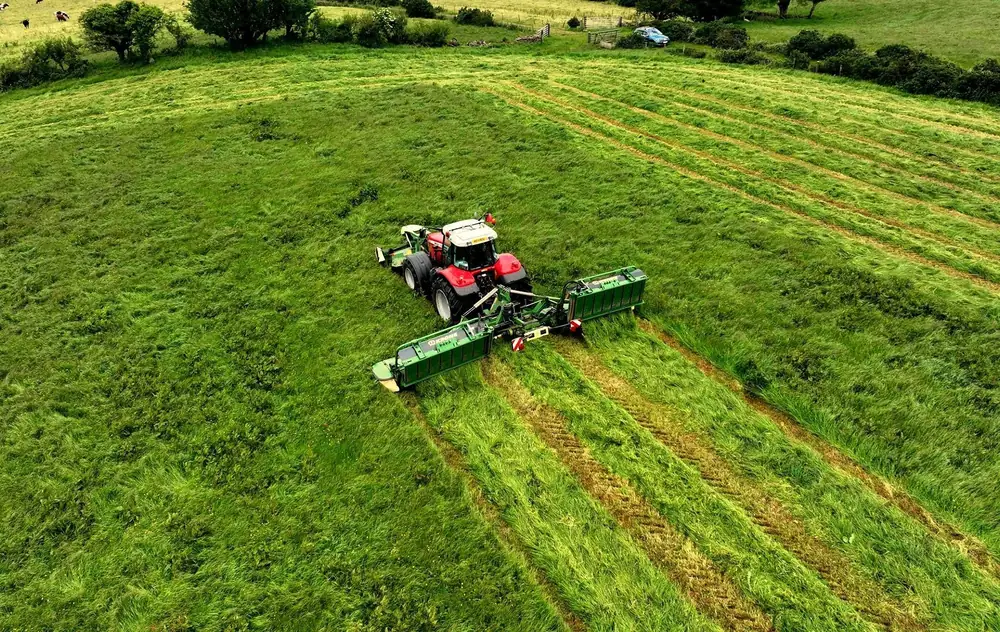
How Much Overlap Auto Steer Removes
Serving the United States
By the Deep Sand Technology support team · authorized FJDynamics dealer · selling, shipping and supporting autosteer in all 50 states
The math, by implement width
- Created by Farmers for Farmers
- Buy-Back Guarantee
- Two-Year Warranty
- Precision Products for New and Older Equipment
Call or text 8:00 am to 8:00 pm, seven days a week.
Deep Sand Technology sells, ships and supports FJD auto steer in all 50 states. Questions while you read? Call or text (580) 394-0089.
Overlap is the cost you are already paying
Every pass you drive by eye, you overlap the last one a little so you do not leave a strip. That overlap is seed, fertilizer, chemical and fuel put down twice, and time spent covering ground you already covered. Auto steer on RTK takes the overlap to about an inch. Here is what the studies measured, what the math looks like at your implement width, and how to figure your own number. Percentages and acres; you know your prices.
Deep Sand Technology's take. The overlap savings are real only when the system holds the same line all day, which means RTK. On WAAS you still leave a few inches of overlap to be safe. Tell us your implement widths and acres and we will work the numbers for your farm, not a brochure farm.
- By handAbout 5 percent of the width on average, more on odd fields and at night
- With a lightbarUnder 3 percent
- RTK auto steerAbout an inch. Well under 1 percent on any implement over 30 feet
- Skips drop tooThe strip you missed is a weed strip or an unfertilized strip
What the studies measured
Nobody has to take our word for the hand-steering number; it has been measured a lot.
- North Dakota State University's extension economists put hand-steered overlap at about 10 percent for planters, fertilizer applicators and sprayers, falling to 0.5 percent with guidance, and note that on fields with potholes, waterways and point rows overlap can add up to 15 percent more inputs. (NDSU Extension)
- University of Georgia extension measured operators using foam markers overlapping about 5 percent of the width on every pass, and lightbars cutting that to under 3 percent without adding skips. (UGA Extension)
- University of Wisconsin watched mowers in the field and found overlap from 0.5 to 16 percent, averaging about 5 percent, and machines on auto steer cutting it in half. (UW-Madison IPCM)
- USDA Agricultural Research Service measured guidance cutting overlaps by up to 6 percent of field area and skips by up to 16 percent on fertilizer and herbicide passes, and found new operators overlap about 20 percent more than operators with six or more years in the seat. (USDA ARS, Kharel et al. 2022)
- A three-year side-by-side on small, irregular fields in Finland found auto steer cut overlap and wasted movement by 21 percent, total field time by about 10 percent and fuel per acre by about 20 percent. Big square fields will see less; small odd ones more. (Estonian University of Life Sciences, 2025)
The spread in those numbers is the point. Overlap depends on the operator, the field shape, the light and how tired you are at 11 at night. Auto steer makes it the same number every pass: about an inch on RTK.
The math at your implement width
Overlap as a share of your inputs is just the overlap width divided by the implement width. Here is what that comes to.
| Implement width | 1 inch (RTK auto steer) | 6 inches (good operator, daylight) | 1 foot (typical) | 2 feet (night, odd field) |
|---|---|---|---|---|
| 30 ft drill or planter | 0.3% | 1.7% | 3.3% | 6.7% |
| 40 ft drill or planter | 0.2% | 1.2% | 2.5% | 5.0% |
| 60 ft drill or air seeder | 0.1% | 0.8% | 1.7% | 3.3% |
| 90 ft boom | 0.1% | 0.6% | 1.1% | 2.2% |
| 120 ft boom | 0.1% | 0.4% | 0.8% | 1.7% |
To turn a percentage into acres, multiply by your acres. One foot of overlap on a 40-foot drill across 2,000 acres is 50 acres seeded and fertilized twice. On RTK it is about 4. One foot on a 90-foot boom across 5,000 sprayed acres is 55 acres sprayed twice, every application; on RTK it is about 5.
Those same overlapped acres are also driven acres: the extra passes, the hours, the fuel and the wear are the same percentage. On a 2,000-acre drill at one foot of overlap you drive roughly 50 acres' worth of extra passes per seeding.
The other half: skips
The reason people overlap by hand is fear of the skip. A skip in the drill is a strip of bare dirt that is a weed strip by June. A skip in the spray pass is the weeds that got away, and the second trip to get them. NDSU and USDA both found guidance cuts skips at the same time it cuts overlap, because you no longer have to err one way or the other. On the coverage map you can see a skip before you leave the field. On an ISOBUS kit the boom sections shut themselves off over painted ground, so the headland and the point rows stop being double-sprayed too.
What it does and does not change
Auto steer changes how much of the field gets covered twice. It does not fix a bad A-B line or a boom that is not the width the screen thinks it is. Rate and population are a separate job: the FJD system sends GPS and speed to the rate controller or planter monitor you already run, or we offer rate and section controllers that work on the same display. And the savings on a square 160 with no obstacles are smaller than on a quarter with a creek, three terraces and a pivot; the studies that measured the biggest savings were on small, irregular fields.
How to figure your own number
- Pick the implement you run the most acres with and its width.
- Be honest about your overlap by hand. Measure it: at the end of a pass, step off from the edge of this pass to the edge of the last one. Daylight with a marker is usually six inches to a foot; at night, more.
- Divide by the width. That is the percentage of seed, fertilizer, chemical, fuel and hours you are putting down twice.
- Multiply by your acres for that implement. Those are your double acres per season.
- Subtract the RTK number: about an inch, so roughly a tenth to a third of a percent.
Or send us the implement widths and acres and we will do it for you.
What to send us for a quote
- Your main implements and their widths
- Acres you cover with each per season
- Whether you plant on last year's rows or run the same tracks
- Whether you have RTK now, and from whom
After the sale
Autosteer quits in the middle of planting. Who picks up the phone?
We do. You get a tech on the phone right away, and we can remote into your display while you sit in the cab. That is usually faster than waiting on a dealer truck.
- 01
Before you buy
Call or text and talk to a farmer. Quotes are delivered the same day, and we match the kit to your tractor before anything ships.
- 02
Before it ships
We offer both radio and NTRIP RTK, and every system ships set up on NTRIP RTK. Most orders ship within 24 hours.
- 03
Install day
Most farmers install it themselves in an afternoon with our tech on the phone.
- 04
In the field
Call or text 8:00 am to 8:00 pm, seven days a week. We can remote into your display while you sit in the cab.
Common questions
Is the savings only on inputs?
No. Overlapped acres are driven acres, so the same percentage comes off hours and fuel, and off wear on the drill and the tractor. A three-year Finnish field study measured about 10 percent less field time and about 20 percent less fuel per acre on small irregular fields. Big square fields will be lower.
Do I need RTK for this, or does WAAS get me most of it?
WAAS drifts a few inches to half a foot through the day, so you still set a few inches of overlap to be safe. That is better than by hand but not the one-inch number. RTK is what takes overlap to about an inch and keeps it there.
What about the headlands and point rows?
That is where the biggest double-coverage usually is, and steering alone does not fix it. ISOBUS section control on the AT2, AT2 Max or AT2 Ultra shuts boom sections or planter sections off over ground that is already painted. On the drill side, the coverage map at least shows you where you doubled.
My fields are big and square. Does any of this matter?
Less. A foot of overlap on a 120-foot boom is under 1 percent. Where it still matters on a big square field is skips, night work and repeatability: planting on last year's rows and spraying between them.
Where does the "about an inch" come from?
RTK correction from a base station you own or from the GEODNET network over cellular. Our guide on what RTK costs to run covers the options and which ones have no network fee.
It's easy to get started.Talk to a farmer today.
More on auto steer
Auto steer for tractors · How auto steer works · Is my tractor steer-ready? · Auto steer for older tractors · Hydraulic auto steer (AH2) · AS2 steer-ready · Compare FJD auto steer systems · Tractor GPS systems · RTK vs WAAS · FJD AT2 vs Wheelman · FJD AT2 vs Trimble EZ-Steer · What auto steer costs · FJD AT2 vs Ag Leader · FJD AT2 vs FieldBee · FJD AT2 vs Outback · FJD AT2 vs Raven · All buyer guides · Autosteer solutions across the United States
Published 10/16/2026 by the Deep Sand Technology support team. Updated 11/1/2026. Written from the installs we walk farmers through and our support calls on farms across the US, not from a brochure.

About Deep Sand Technology
Deep Sand Technology (Deep Sand Tech) is a farmer-owned, authorized FJDynamics dealer with over 30 years of experience. We sell, ship and support FJD autosteer kits and GEODNET network RTK for thousands of farmers across the US, in all 50 states. Everything on this page comes from the installs we walk farmers through and our support calls, not from a brochure.
About us · Farmer reviews · Talk to a farmer · Call or text (580) 394-0089
Learn more about
Deep Sand Tech
Serving the United States. Deep Sand Tech specializes in affordable, industry leading, agricultural autosteering systems and agtech management support. Two-year warranty. Buy-back guarantee. Talk to a farmer today.
Watch Video